Parth Abhyankar
June 22, 2026 · 4 min read
The Quiet Cost of Too Many Subscriptions: Getting a Grip on SaaS Sprawl
Most growing businesses have never seen their full software bill in one view. Here is how to spot SaaS sprawl and decide what to cut or build.
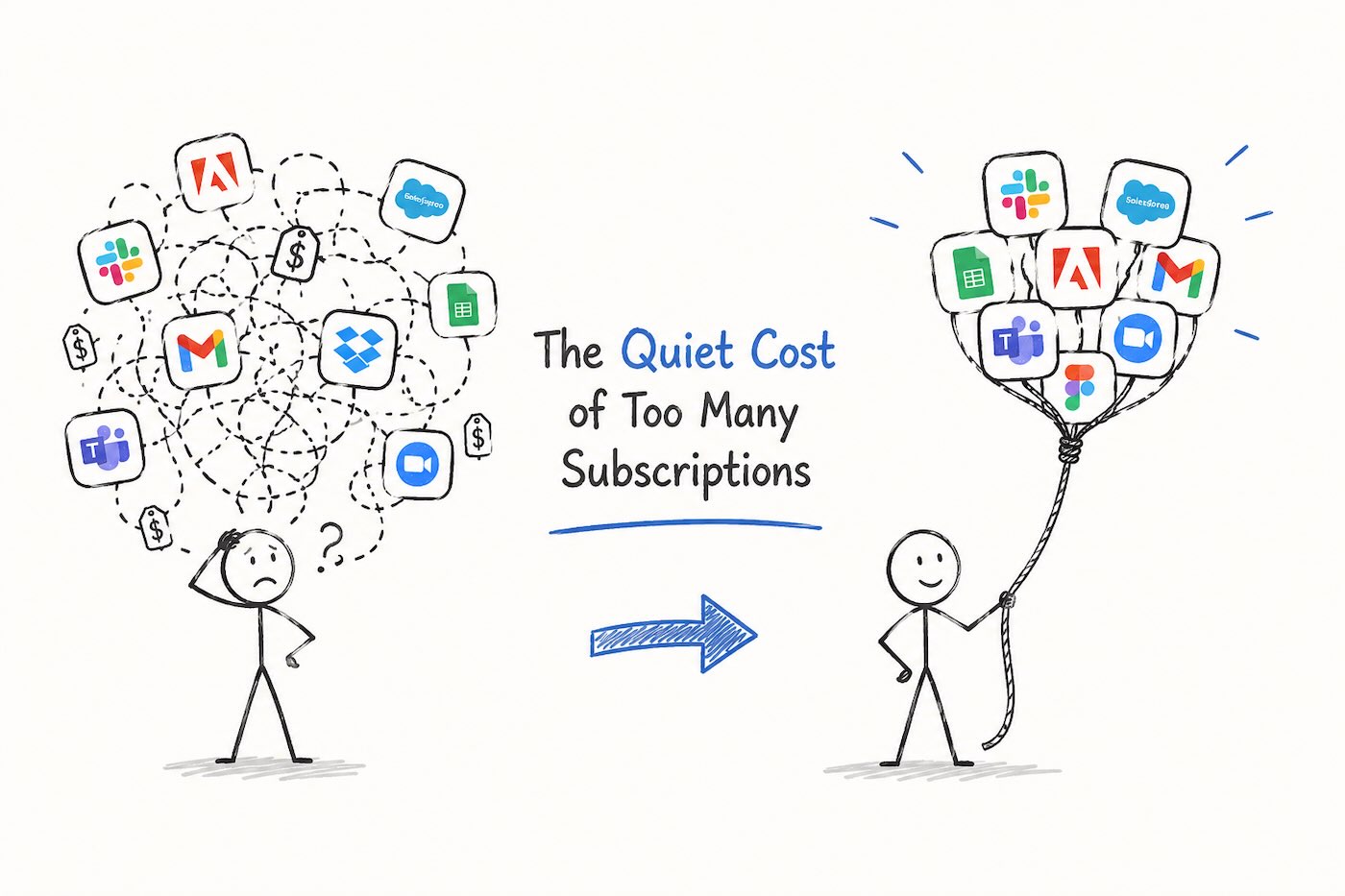
Last month a client asked me to help them figure out why their software bill had quietly crossed a number that made them uncomfortable. We sat down and listed every subscription. It took us almost two hours. By the end we had counted more than forty tools. Nobody in the company could explain what nine of them were for. Two were being paid for by two different departments, for the same job.
This is not a rare story. It has a name now. People call it SaaS sprawl, and it is one of the most common and least talked about ways that growing businesses leak money.
What SaaS sprawl actually is
Software as a service made buying tools easy. Too easy, in some ways. A team lead can sign up for a new app with a company card in five minutes, no IT approval, no procurement meeting. That convenience is genuinely useful. The problem is that it happens dozens of times across a company, and nobody is keeping the full list.
The numbers back this up. Industry research for 2026 puts the average company at roughly 100 distinct SaaS applications, and a meaningful share of those, often a third or more, sit unused or barely used. Gartner has estimated that organisations overspend on SaaS by around 25 percent against what they actually need. For a business spending a few lakhs a year on software, that is real money walking out the door every month.
Why it sneaks up on you
Sprawl is rarely the result of one bad decision. It is the result of fifty small, reasonable ones. A trial that nobody cancelled. A tool the team stopped using but the renewal kept charging. Two apps that do eighty percent of the same thing, bought a year apart by people who never compared notes.
There is a hidden cost beyond the invoices too. Every tool is another login, another place your customer data lives, another integration that can break, another vendor you depend on. When your information is scattered across forty systems, simple questions take longer to answer because the data never sits in one place.
What to do about it
You do not need a consultant for the first step. You need a spreadsheet and an afternoon.
List every subscription you pay for. Put the monthly cost, the owner, and what it is actually used for next to each one. The exercise itself usually surprises people. Once the list exists, three patterns tend to jump out. Some tools are pure waste and can be cancelled this week. Some overlap, and you can keep one and drop the other. And a few are doing critical work that you would never want to lose.
That last group is where the interesting decision sits. When five separate subscriptions are really propping up one core workflow, it is sometimes cheaper and far less fragile to replace them with a single system built around how you actually work. We did exactly this for Deccan Education Society, where one multi-site platform now runs more than twenty school websites that would otherwise have meant twenty separate setups and twenty separate bills.
Custom software is not the right answer for everything. For email, accounting, or design, an off-the-shelf subscription is almost always the sensible choice, and building your own would be a waste. The case for custom software gets strong only when a workflow is central to your business, when no single tool fits it well, and when you are paying for three or four products to cover the gaps between them. At that point the monthly subscriptions you cut can fund the thing you build.
The takeaway
Sprawl is not a technology problem. It is a visibility problem. Most businesses have never seen their full software list in one view, so they cannot make good decisions about it. Make the list first. Cancel the obvious waste. Consolidate the overlaps. And only then ask the harder question of whether a few of those recurring bills are quietly telling you that you have outgrown renting and it is time to own.
If you want a second pair of eyes on where your software spend is going, or whether a custom platform would actually save you money, get in touch. Happy to talk it through, no sales pitch.
Monthly newsletter
Found this useful?
Get our monthly insights — no fluff.
You're subscribed. Talk soon!
Was this article useful?
Keep reading