Parth Abhyankar
June 24, 2026 · 5 min read
Before You Buy an AI Agent: A Practical Filter for Smaller Businesses
Gartner expects 40%+ of agentic AI projects to be scrapped by 2027. A practical three-question filter for SMEs deciding whether to buy an AI agent.
Before You Buy an AI Agent: A Practical Filter for Smaller Businesses
Gartner made a prediction last year that keeps coming up in my conversations with clients. By the end of 2027, it expects more than 40% of agentic AI projects to be scrapped. The reasons are not exotic: costs that climb faster than expected, value that nobody can quite point to, and risk controls that were never really thought through. A June 2026 follow-up looking at retail at the store level found much the same pattern playing out on the ground.
I am not sharing this to talk anyone out of AI. We build software for a living, and a fair bit of what we build now has some form of automation or machine learning inside it. The point is narrower. A lot of money is being spent on "agents" that were never going to work, and most of that waste was avoidable with a few honest questions asked early.
What is actually being sold
An AI agent, in the way the term is used today, is software that can take a goal and carry out a sequence of steps to reach it, calling tools and making decisions along the way, with limited human input. That is the promise. The reality in mid-2026 is more uneven.
Gartner pointed out something worth repeating. Of the thousands of vendors describing their products as agentic, only a small number are doing anything that meets the description. The rest are doing what Gartner calls "agent washing," which is putting a new label on a chatbot or a rules engine that existed last year. For a buyer this matters a great deal, because you can pay agent prices for a tool that is really just a form with a friendlier face.
A filter I have started using
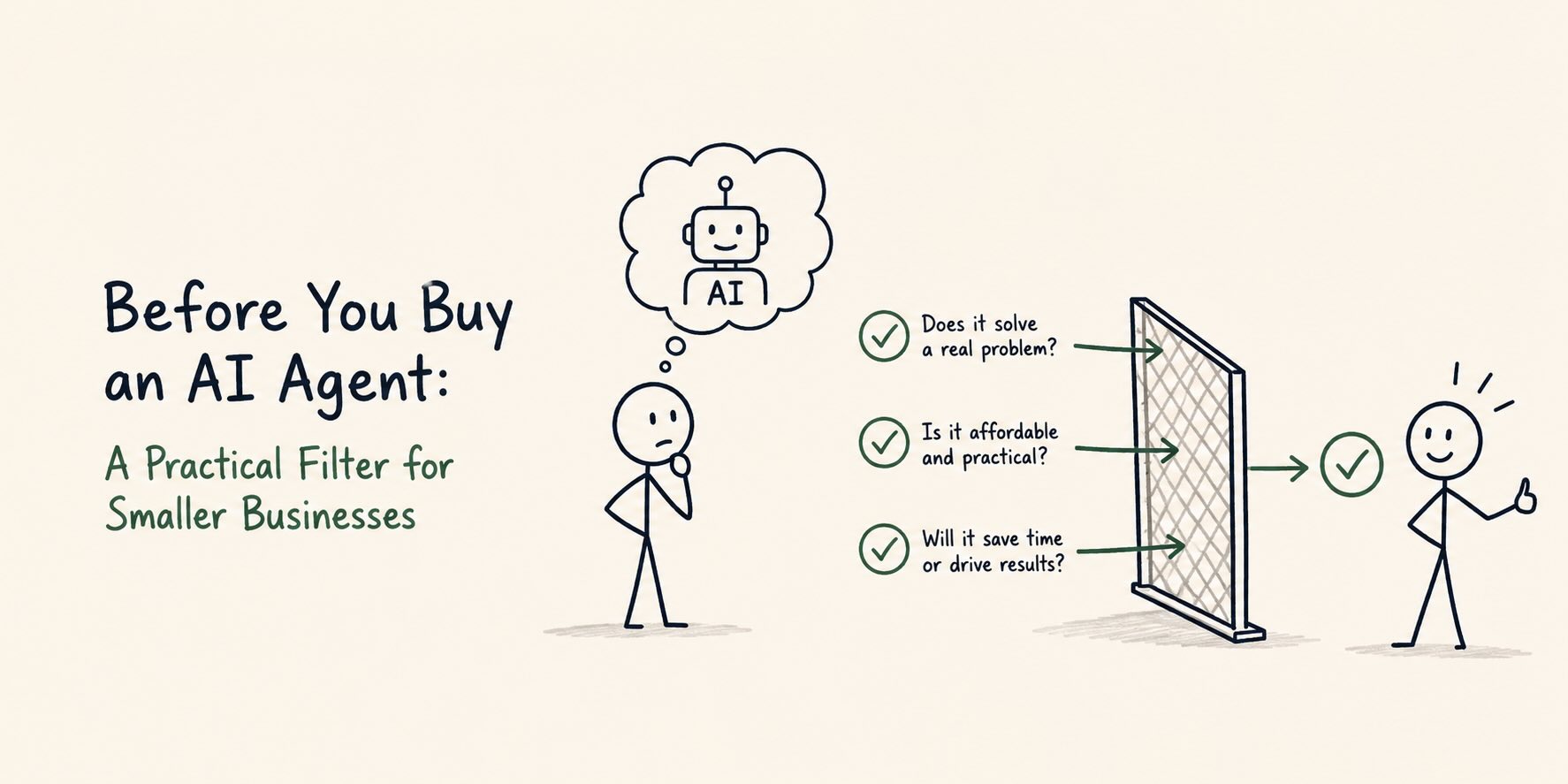
When a client asks whether they should bring in an agent for a task, I ask three things before anything else.
First, can you describe the task as a series of repeatable steps? If a person on your team can write down what they do each time, you have a candidate for automation. If the task changes shape every time and depends on judgment built over years, an agent will struggle and you will spend your days correcting it.
Second, what does one mistake cost? An agent that drafts internal summaries can be wrong now and then with little harm. An agent that issues refunds, sends quotes, or touches customer records is a different matter. The higher the cost of a wrong move, the more guardrails you need, and guardrails are where budgets quietly disappear.
Third, can you measure the result in money or hours? If you cannot say what good looks like before you start, you will not be able to tell whether the thing is working six months in. This is the single most common reason these projects get cancelled. Nobody set a target, so nobody could defend the spend.
Where the value usually is for smaller firms
In our experience the wins for a small or mid-sized business are rarely the dramatic ones. They are the dull, repeated tasks that eat an hour here and an hour there. Pulling data from invoices into a sheet. Drafting first-pass replies to common enquiries. Flagging the orders that look unusual. These are bounded, measurable, and forgiving of the occasional error. They also do not require a grand platform. Often the right answer is a small piece of custom software that does one job well and connects to the systems you already run.
The opposite pattern is the one to watch. A broad promise to "automate operations," a price that assumes you will figure out the value later, and a demo that works beautifully on a tidy example. That is usually where the 40% comes from.
The quieter cost
There is also the subscription angle, which I wrote about recently in the piece on SaaS sprawl. Every agent you sign up for is another monthly line item, another login, another thing to maintain. Two or three of these and you are paying real money before you have proven any of it works.
None of this means waiting on the sidelines. It means starting small, picking a task you can measure, and being willing to stop if the numbers do not show up. If you want a second opinion on whether a particular process is worth automating, or whether an off-the-shelf agent is the right fit versus something built for your workflow, we are happy to talk it through. No pitch, just an honest read.
Sources: Gartner press release, June 2025; IHL Services analysis, June 2026
Monthly newsletter
Found this useful?
Get our monthly insights — no fluff.
You're subscribed. Talk soon!
Was this article useful?
Keep reading