Resonics Team
May 25, 2026
How We Built 20+ School Websites on a Single Platform for Deccan Education Society
How Resonics, a Laravel web development company, built a multi-tenant CMS for Deccan Education Society to manage 20+ school websites from one platform. A case study in multi-site CMS development, centralized control, and local autonomy for education trusts.
How We Built 20+ School Websites on a Single Platform for Deccan Education Society
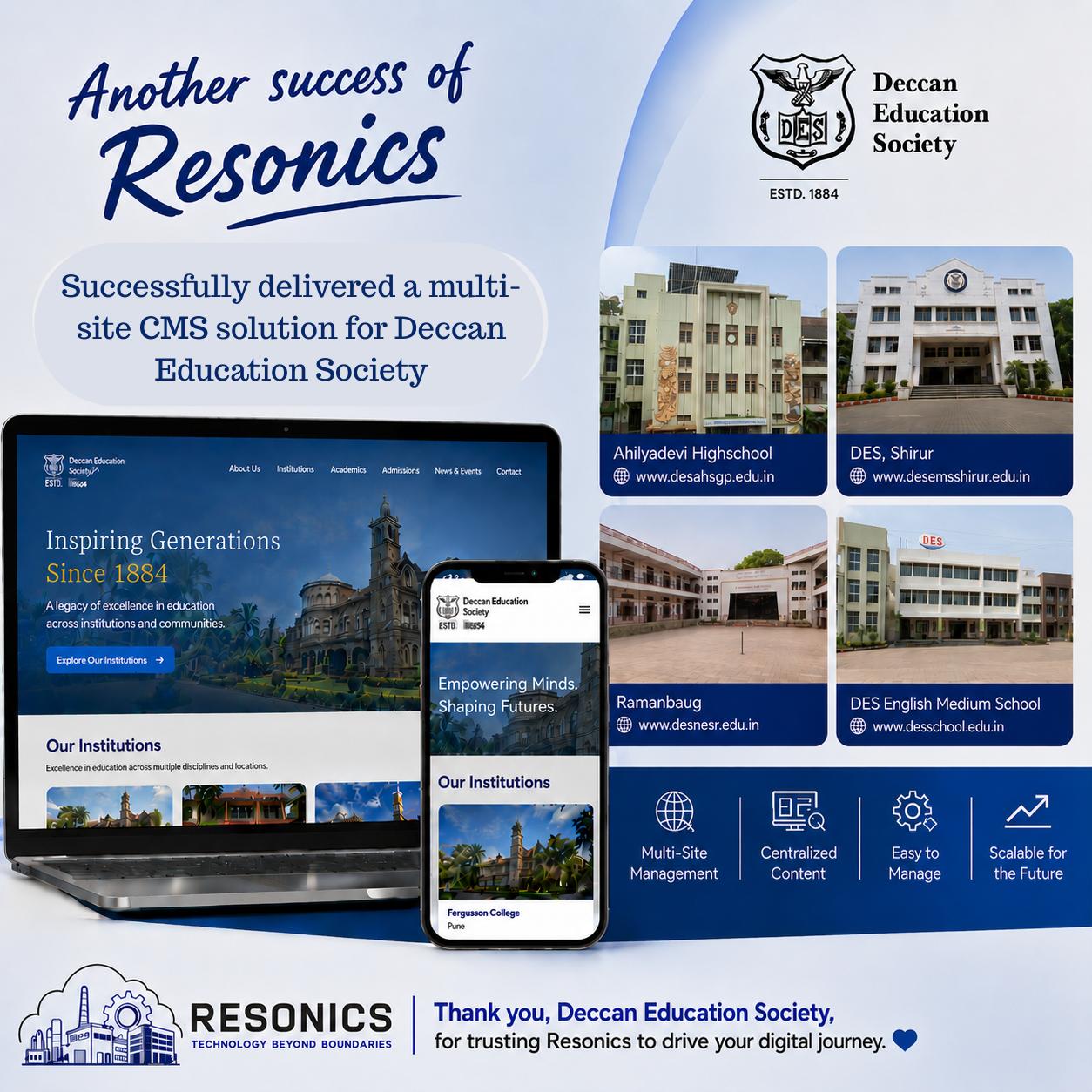
Managing 20+ school websites used to mean running 20+ separate systems. We built a unified multi-tenant CMS that lets Deccan Education Society manage every school from one place, while each school keeps its own identity, branding, and content control.
Deccan Education Society (DES) is one of Maharashtra's most respected education institutions, with a legacy stretching back over a century and more than 20 schools operating across the state. Every school needed its own website with its own branding, events calendar, announcements, admission information, and day-to-day management tools. On paper that sounds simple. In practice, maintaining 20+ disconnected websites had quietly grown into an operational and financial drain, and it is a problem we see across nearly every large education trust, franchise network, and multi-branch organization we talk to.
This post walks through how we approached the problem, what we built, and why the architecture matters, whether you are the owner of an education society weighing the cost of your current setup or a CTO evaluating how a multi-site CMS should actually be engineered.
The Real Problem Behind "We Need Some Websites"
When an organization runs many branches, the website problem is never really about websites. It is about who controls what, who pays for changes, and how long anything takes.
For DES, the pain showed up in familiar ways:
- Every site was its own island. Different vendors, different technologies, and different logins meant there was no single source of truth and no consistency across the institution's digital presence.
- Every small change needed a developer. Updating an exam timetable, posting a holiday notice, or adding a new staff member turned into an email, a quote, and a wait. Multiply that across 20+ schools and the delays and costs compounded fast.
- The central office had no visibility. Leadership could not see, at a glance, which school sites were updated, which were outdated, or which were even online.
- Security and maintenance were a gamble. Twenty different codebases meant twenty different things that could break, get hacked, or fall out of date. A vulnerability patched on one site could sit wide open on the other nineteen.
- Onboarding a new school took weeks. Each new institution meant starting almost from scratch.
If you run a multi-location business, this list probably feels uncomfortably familiar. The cost is rarely a single big number. It is the slow leak of admin time, vendor invoices, and missed updates that add up over years.
What DES Actually Needed
The brief, once we distilled it, came down to a single tension that defines almost every multi-site project: centralized control with local autonomy.
- School principals and their staff needed to update their own websites directly, without raising a support ticket or paying for every edit.
- The central DES administration needed oversight and governance across all schools from one dashboard.
- The whole system had to be fast, secure, and genuinely low-maintenance, because an education trust should be spending on education, not on firefighting websites.
Balancing those needs is exactly where a generic website template or an off-the-shelf builder falls apart. Solving it properly is an architecture decision, not a design decision.
Our Approach: A Multi-Tenant CMS
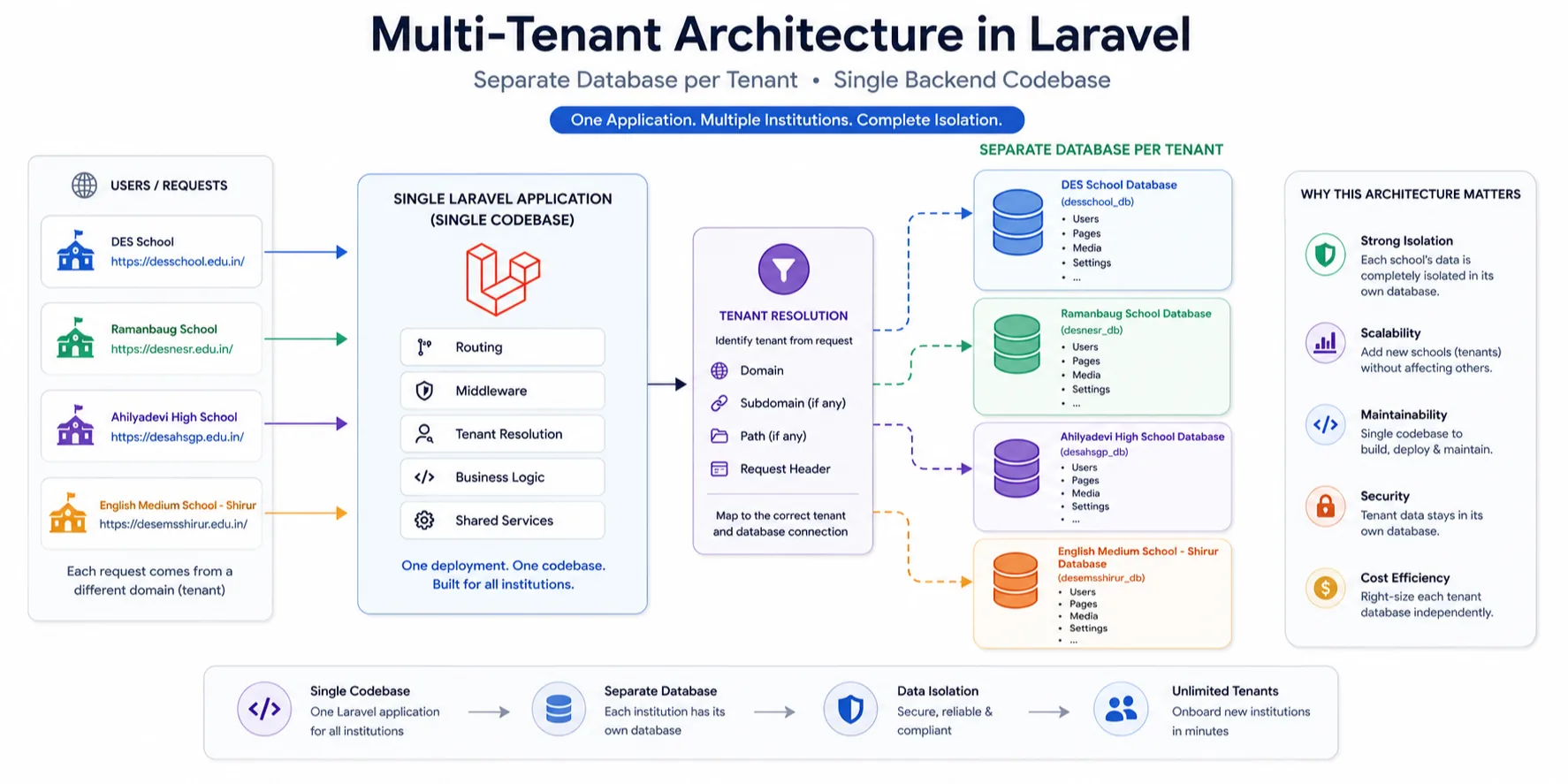
We designed and built a multi-tenant content management system. In plain terms, every school operates on its own website with its own subdomain, its own branding, and its own content panel, while all of them run on a single shared, centrally maintained codebase.
Think of it like an apartment building. Every family has their own front door, their own keys, and their own furniture, but they all share one well-managed foundation, plumbing, and security system. The residents get independence; the building owner gets efficiency and control. That is multi-tenancy, applied to websites.
We built the platform on Laravel, a mature and secure framework we have used as our core stack for over 13 years to deliver enterprise systems across banking, healthcare, education, and infrastructure clients. For a CTO, the relevant point is not the brand name of the framework but what it buys you: one codebase to secure, one place to patch, and a well-understood structure that any competent Laravel team can maintain for years rather than a fragile custom build that locks you in.
What we engineered into the platform
- Per-school admin panels with role-based access control, so a principal sees and manages only their own school, while central administrators see everything. Permissions are defined by role, not by trust.
- A centralized content approval workflow, giving the head office optional governance over what goes live without becoming a bottleneck for routine updates.
- A shared media library with school-level organization, so assets stay organized per school but common resources can be reused.
- Dynamic event and announcement modules, letting non-technical staff publish notices, calendars, and updates in minutes.
- Per-school admission enquiry management, so prospective-parent leads are captured and routed to the right school rather than lost in a generic inbox.
- Built-in SEO tools for each school's individual site, because each institution needs to be found by parents searching for it by name and by locality.
Why this architecture matters (the part a CTO will care about)
The value of multi-tenancy is what it eliminates. Instead of 20+ codebases, there is one. That single decision cascades into real, measurable advantages:
- Security is centralized. Patch once, protect everyone. There is no scenario where one neglected site becomes the weak link that exposes the institution.
- Maintenance cost drops sharply. One codebase means one upgrade path, one testing cycle, and one team that understands the whole system.
- Onboarding a new school is configuration, not construction. Spin up a subdomain, set the branding, assign the admins, and a new school site is live in hours instead of weeks.
- The platform scales cleanly. Whether DES runs 20 schools or 50, the architecture does not fundamentally change. Growth becomes a setting, not a project.
This is the difference between buying twenty websites and investing in one platform that happens to serve twenty schools. The first is an expense that repeats forever. The second is an asset that compounds in value.
The Result
DES now manages all 20+ school websites from a single platform.
- New school sites are onboarded in hours, not weeks.
- School administrators update their own content daily, without waiting on a developer or paying per change.
- The central team has complete visibility across every site from one dashboard.
- Security and maintenance happen once, centrally, instead of twenty times over.
What used to be an administrative burden is now a manageable, scalable digital asset that grows with the institution. The schools kept their individual identities. DES gained control, consistency, and a platform built to last.
This remains one of the projects we are proudest of, because it shows what becomes possible when software is designed around a real organizational challenge instead of forced into a generic template.
Few links to the websites deployed using our platform
DES School https://desschool.edu.in/
Ramanbaug School https://desnesr.edu.in/
Ahilyadevi High School https://desahsgp.edu.in/
English Medium School - Shirur https://desemsshirur.edu.in/
Run an Education Trust With Multiple School Websites?
If you are a school, college, or education society juggling several websites, several vendors, and several logins, the problem DES faced is almost certainly costing you more than you think, in admin hours, vendor fees, and missed updates. A purpose-built multi-tenant CMS replaces that sprawl with a single education platform you control, where every institution keeps its own identity and the head office keeps oversight.
Talk to us about your school or college website and we will tell you honestly whether a unified platform is the right move for you.
Looking for a Serious Laravel Development Partner?
Multi-tenant CMS work is only one example of what we do. We are a Laravel web development company with over 13 years of experience building custom software, web applications, ERPs, and management platforms for clients across education, banking, healthcare, and infrastructure. If you are an owner or CTO who needs a dependable Laravel development team, not a template factory, we build software designed around your actual business problem and engineered to last.
Tell us what you are trying to build and we will give you a straight answer on scope, approach, and fit.
Monthly newsletter
Found this useful?
Get our monthly insights — no fluff.
You're subscribed. Talk soon!
Was this article useful?
Keep reading