Parth Abhyankar
June 22, 2026
Why Most AI Agent Projects Fail, and How to Run One That Actually Pays Off
Most AI agent projects stall before they deliver value. Here is a practical, no-hype look at why that happens and how a growing business can get real returns.
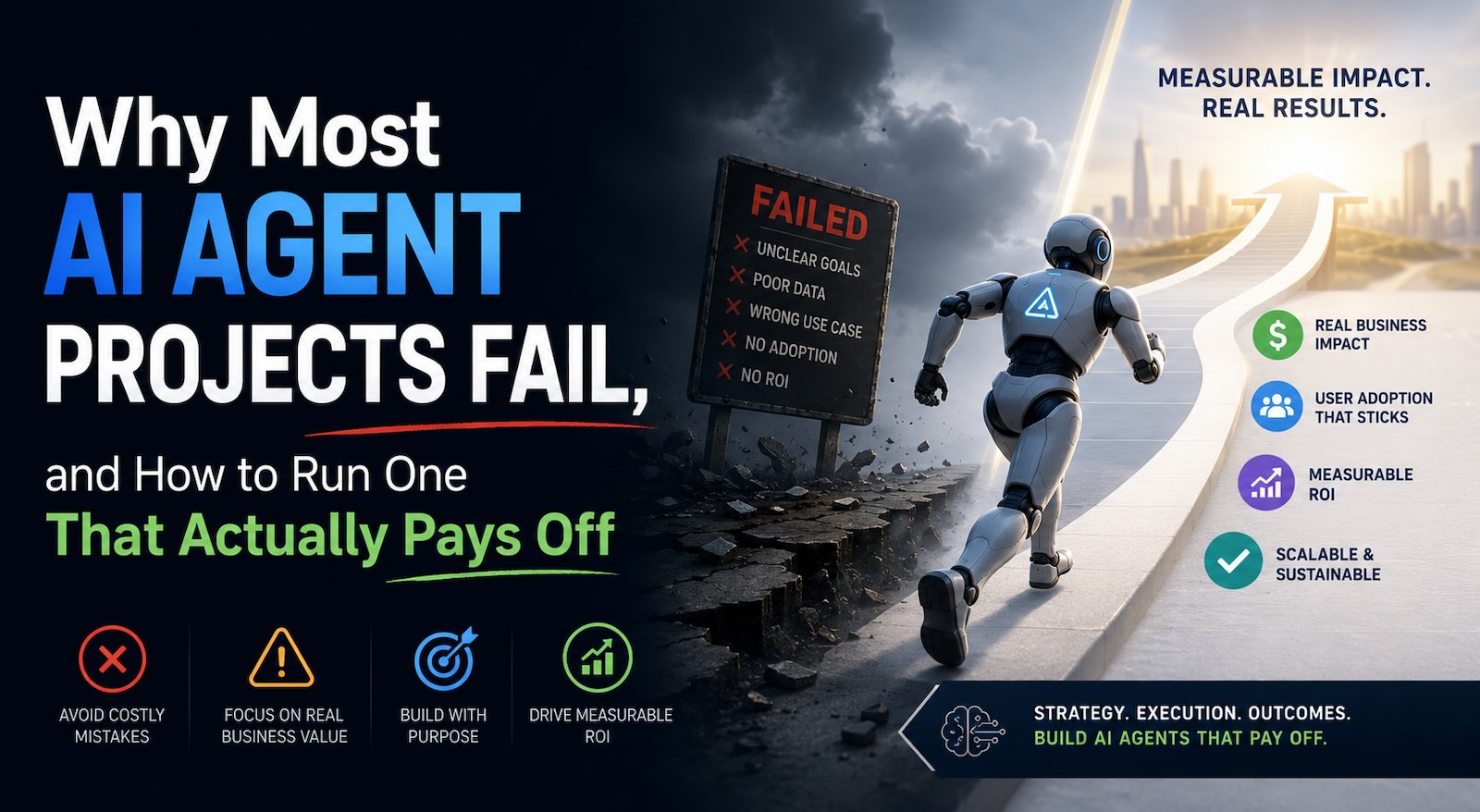
Almost every business owner I speak with this year has the same question in some form. Should we be doing something with AI agents, and are we already behind? It is a fair worry. The noise around agents has been relentless, and a lot of it makes it sound like you flip a switch and half your admin work disappears.
The reality on the ground is more sober. A widely cited MIT study found that around 95% of generative AI pilots inside companies were not delivering any measurable return. That number gets thrown around as proof that AI is overhyped. I read it differently. The technology mostly works. What fails is how projects get chosen, scoped, and run.
So before you spend a rupee on an agent, it is worth understanding why so many of these projects quietly stall.
The first reason is that businesses pick the wrong job for the agent. More than half of AI budgets go into sales and marketing, because that is where the excitement is. But the same MIT research found the strongest returns sitting in the back office. The dull stuff. Reconciling invoices, chasing missing documents, sorting support tickets, pulling the same report every Monday. These tasks are repetitive, rule-heavy, and expensive in human hours. That is exactly where an agent earns its keep.
The second reason is impatience. When projects were reviewed after they failed, the most common explanation owners gave was expecting too much, too fast. A demo runs beautifully on clean, tidy data with one person clicking through a script. Then it meets your actual business, with messy records, three people doing the same thing differently, and edge cases nobody documented. The gap between the demo and daily use is where most of the disappointment lives.
The third reason is the least glamorous and the most important. Your data. An agent that reads from a spreadsheet three people update by hand, or a customer list with the same client entered four times, will produce confident answers that are quietly wrong. Cleaning that up first is not exciting work, but it is usually the difference between a tool you trust and one you stop using after a month.
None of this means you should wait. It means you should start small and start somewhere boring.
Here is the approach I would suggest to any business owner. Pick one process that annoys you every single week. Something you can describe in a sentence and measure in hours or money. Not "improve customer service," but "stop a person spending six hours a week copying order details between two systems." A tight scope like that is testable. You will know within a few weeks whether it works, and you will not have bet the business on it.
Then check whether the data behind that process is in reasonable shape. If it is not, fix that first. It will feel like a detour. It is actually the foundation.
Finally, treat the first project as something you are allowed to stop. The businesses that get real value from AI are not the ones that commit hardest. They are the ones willing to kill a project that is not working and move the effort somewhere it does. A small pilot that pays for itself in three months teaches you far more than a year-long programme that everyone is too invested to question.
That is the unglamorous truth. AI agents are genuinely useful, but the value comes from discipline, not enthusiasm. Choose a narrow, expensive, repetitive task. Get the data underneath it in order. Measure honestly. Expand only what works.
We have spent years building custom software and automation for businesses across healthcare, education, and banking, and the same principle holds whether the tool is an ERP, a workflow system, or an AI agent. The technology matters less than picking the right problem to point it at.
If you are weighing up where automation could actually save your team time, we are happy to talk it through and give you an honest view, even if the answer is "not yet." You can get in touch here. If you found this useful, our piece on what a website redevelopment really costs in India takes the same practical look at another decision businesses tend to overthink.
Monthly newsletter
Found this useful?
Get our monthly insights — no fluff.
You're subscribed. Talk soon!
Was this article useful?
Keep reading