
Parth Abhyankar
June 24, 2026 · 4 min read
Your business probably outgrew Excel / Google Sheets about two years ago. Here's how to tell and what it actually costs to fix it
Most businesses start on Excel or Google Sheets and it works. But once you cross 10 employees, spreadsheets silently start costing you time, money, and customers.
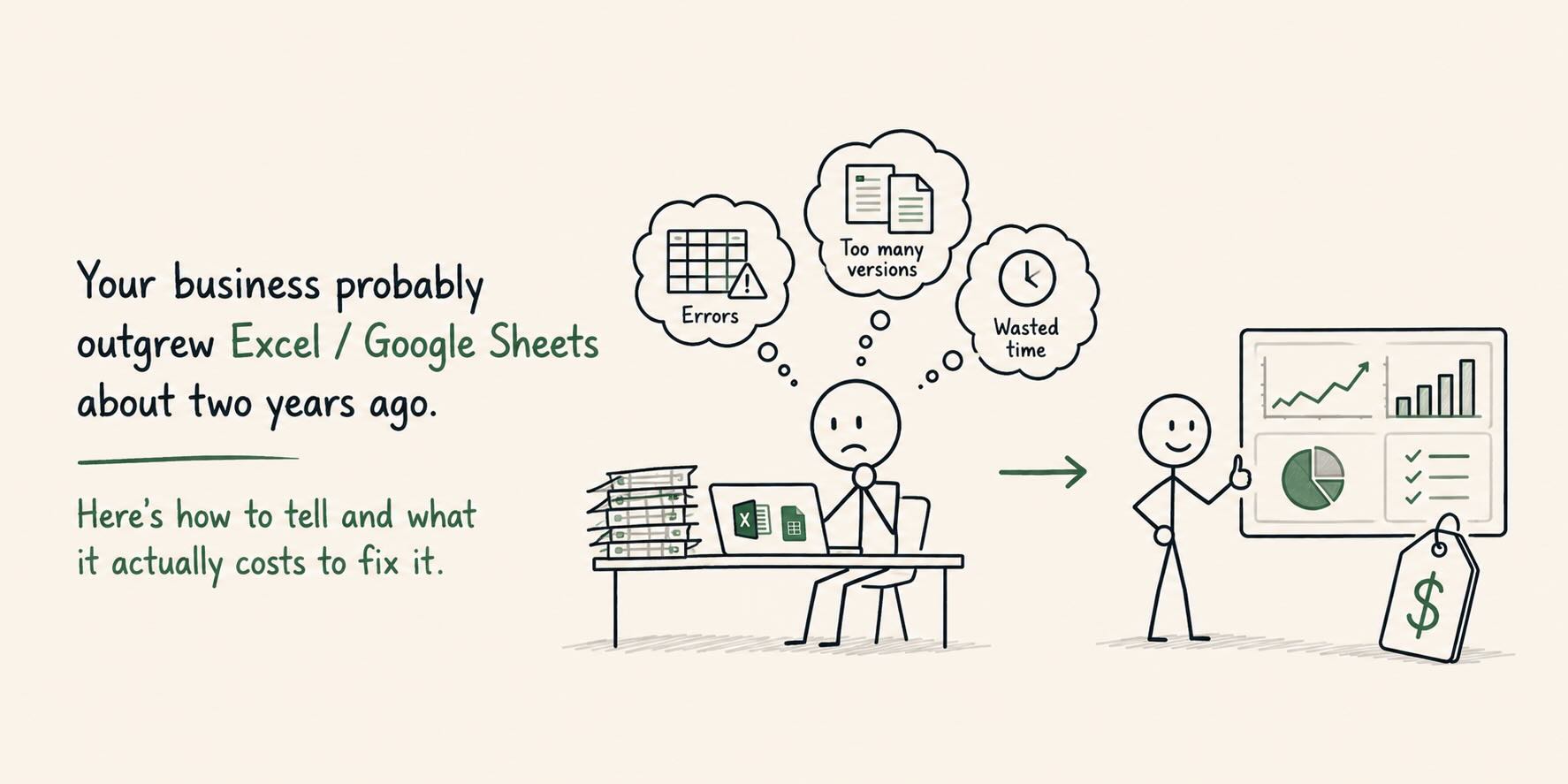
Your business probably outgrew Excel about two years ago. Here's how to tell and what it actually costs to fix it
As a founder based in Pune, I talk to local business owners every week. Most of them run their operations on Excel. Do not get me wrong, because it is a fantastic tool. I still use it for quick math. But if you have more than ten employees, Excel is probably hurting your business.
My name is Parth. Over the last 13 years, my team and I have built custom software for healthcare clinics, educational institutes, and local banks. I see the exact same pattern in almost every industry. People use spreadsheets for jobs they were never built to do. It happens naturally, but it eventually creates a massive bottleneck.
Why does this happen? The reason is simple. When you start a company, you need a cheap way to track things. You open a new spreadsheet and add columns for customer names, dates, and payments. It works perfectly for a year or two.
Then your business grows. You hire more staff. Suddenly, you have five people trying to edit the same file at the same time. Someone accidentally deletes a complicated formula. Another person saves a copy on their desktop and works on outdated numbers for a week.
The mistakes pile up quickly. According to Forbes, nearly 90% of spreadsheets contain significant errors. When you rely on a broken sheet, you start making bad decisions. You might order the wrong inventory or miss a vendor payment. The exact tool that helped launch your business is now slowing you down.
Let us look at what this actually costs your company.
First, there is a massive time cost. Your team probably spends hours every week copying and pasting data. They hunt for mistakes. They email files back and forth to get approvals. That is an expensive waste of effort.
Second, there is a very real risk of losing money. Back in 2012, JP Morgan famously lost over six billion dollars because of a copy and paste error in a single Excel file. Your business might not lose billions, but a missing zero can still ruin your monthly cash flow.
Third, you lose basic visibility. A spreadsheet cannot send an automatic text message when a patient misses an appointment. It will not alert your sales team to follow up with a warm lead. You are driving a car with a blindfold on.
I remember a client we worked with recently. They managed transaction records across 15 spreadsheets. When a customer walked in, the front desk had to search multiple files just to find their transaction history. It took ten minutes for the customer. We stepped in and built a secure central database. Today, pulling up a file takes two seconds.
How do you know it is time to move on? Look for these three clear signs.
-
First, you have a designated "spreadsheet guy." If only one person in your office knows how the main tracker works, you are in a dangerous position. If they quit, your operations freeze.
-
Second, your files take a long time to open. A spreadsheet should not take thirty seconds to load. If it does, you have way too much data inside.
-
Third, you spend more time managing the file itself than actually looking at the data.
If this sounds familiar, you need a better system. This is where Custom Software helps. You do not need a massive corporate system. You just need a practical tool built for your daily workflow. Sometimes, even a smart portal created through our Website Development team can automate customer bookings and replace manual sheets.
Upgrading your systems can feel intimidating. It costs money upfront, and your team needs a few weeks to learn the new process. But the long term cost of doing nothing is much higher. You lose time, you lose accuracy, and eventually, you lose good customers.
Stop forcing Excel to act like a database. Give your team the tools they actually need.
If you are tired of fixing broken formulas and hunting for missing data, let us have a chat. Send us a quick message through our Contact page. My team at Resonics will look at your current process and give you an honest answer on how to fix it. No pressure at all, just practical advice from people who build software for a living.
Monthly newsletter
Found this useful?
Get our monthly insights — no fluff.
You're subscribed. Talk soon!
Was this article useful?
Keep reading